


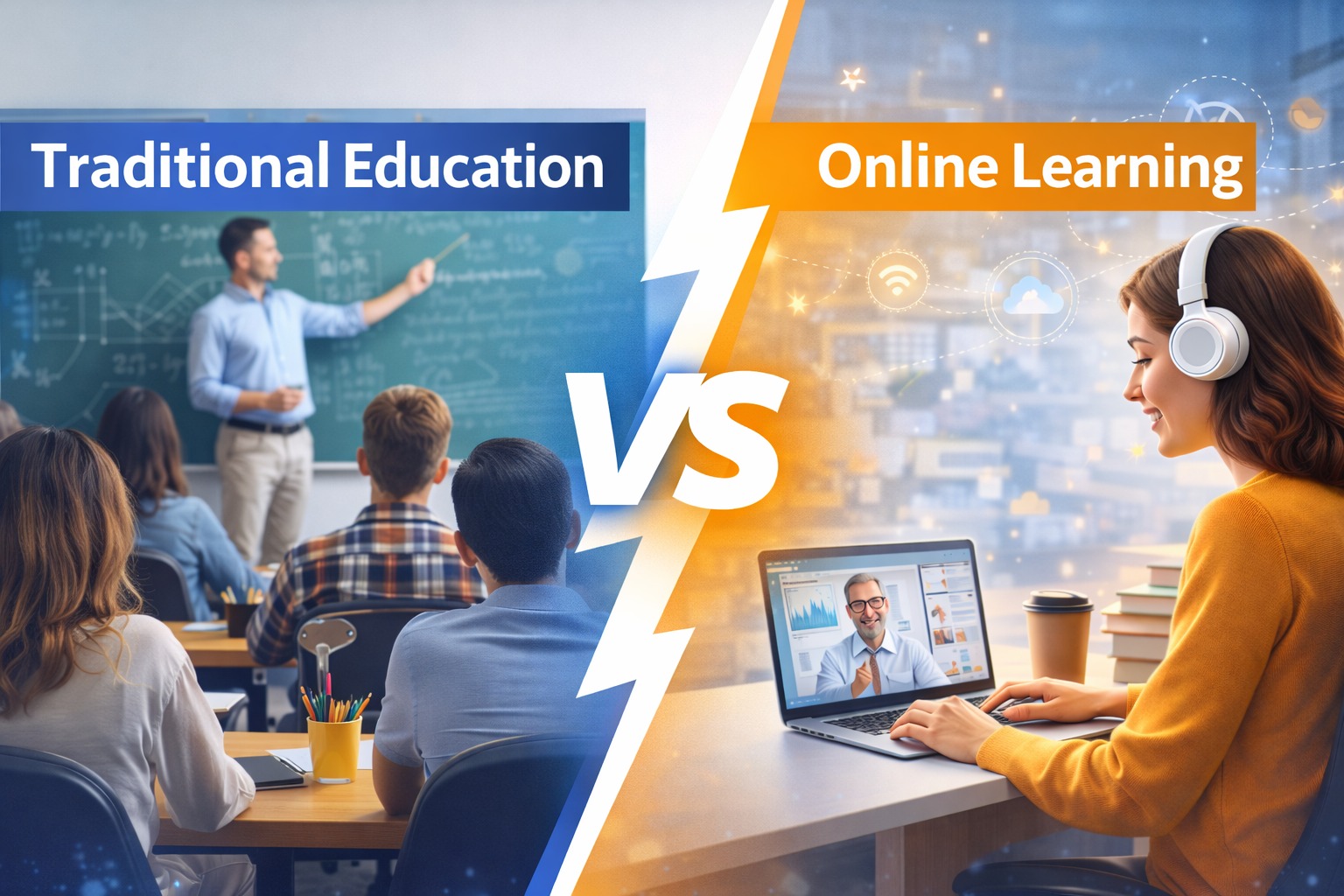
Traditional Education vs Online Learning
From ancient times, education has been an important part of human development and progress, In the last few years however methods for teaching and studying have undergone significant changes. Traditionally, education took place in physical classrooms where teachers and students could interact face-to-face. But with the rise of technology and internet, online learning has emerged as an powerful alternative to traditional education. Today’s education includes both traditional ways along with its technological form, or “cyber scholarship.” bey omnently important in deciding what students learn and their overall progress Traditional Education vs Online Education Traditional Education vs Online Education
Understanding the differences, advantages and challenges of these two educational approaches helps students to choose the way of learning that best suits them. While traditional education offers more structured environments and direct exchanges online learning makes learning flexible and accessible.It encourages learning. Traditional Education vs Online Education
Understanding Traditional Education
Traditional education is the traditional classroom-based way in which a student attends school, college or university in person. Where teachers give lectures, students take part in discussions and learning is arranged according to timetables, in this system. Traditional Education vs Online Education
The heart of traditional education consists of classrooms, textbooks, blackboards and direct interaction with teachers. Students have fixed schedules to keep and go to set locations for classes. Traditional education as a form of learning has prevailed for centuries. It is still widely used across the world. Traditional Education vs Online Education


Computer
Amazon Basicsacer Aspire Lite, AMD Ryzen 3-5300U, 8 GB RAM, 512 GB SSD, Full HD 15.6″/39.62 cm, Windows 11 Home, Steel Gray, 1.59 KG, AL15-41, Premium Laptop
36,xxx from Amazon 36,999 from AmazonAdvantages of Traditional Education
One of the main advantages of traditional education is its face to face interactions. Students can have direct communication with teachers and classmates, which leads to better grasping of ideas when they finally come from the mouth. feedback on the instant from teachers also helps in improving learning. Another advantage is its structured learning environment. Schools and universities provide regular class times, disciplined classrooms and guidance from teachers. This structure helps students to concentrate on their studies. Traditional Education vs Online Education
Traditional education also facilitates social development. Students are in contact with their age-mates, join in group activities and form friendships. In these contacts they develop their skills at communicating, cooperating and handling emotions. Traditional education does not only comprise classrooms and textbooks, but also extra-circular acuivities like sports, debates and cultural events. This can also help to nurture a complete personality.
Traditional Education Challenges
Despite its advantages, traditional education has some drawbacks. One of them is its limited accessibility, for the number of students is restricted. Students have to migrate to an area that is trinning towards providing education, which is rather inconvenient for those living in remote places. Traditional education can also be expensive. For travelers due to the tuition fees, transportation costs plus room and board, as well as learning materials. Traditional Education vs Online Education
A further weak point is the setting of timetables. Classes are held on a certain day and time as students have to know in order not to miss them, this is very inconvenient for people who have jobs or other types of obligations. Additionally, in many traditional classrooms there is a standardized teaching methodology that does not suit the pace at which every student learns. No wonder, then that they become bored and sense no reason why they should even try! (Thrashing About–Is How Most Teachers Would Put It.)
Understanding Online Learning
E-learning, or online learning is also known as digital education and refers to the accessing of educational materials upon internet platforms (invariably called “websites”) and through digital tools (like this pen).
With the advance of technology, online learning platforms, video lectures and virtual classrooms have become quite widespread. Students can not only lithely scrub in on their lessons at their own pace from wherever they happen to be located–or simply take the time when commuting, for we’ve all been spending two hours each day getting home! Experts call this “active-passive learning.” Traditional Education vs Online Education
Benefiting from Online Learning
One of the greatest benefits of online learning for example is its flexibility. Students with access to the internet can study when and where they like–whether at 2 a.m. or while sitting on a bench in his local university town garden waiting for friends on most Sunday afternoons.
Online learning also offers a wide range of courses. Students can sign up for any university or professional institution’s programs throughout the world! Another advantage is affordability: many online courses are more economical than their traditional counterparts. Students can also cut expenses for transport, accommodation and books. Traditional Education vs Online Education
Online learning can enable students to learn digital tools such as online communication, research methods and the use of technology. These capabilities are highly valued in today’s workplaces.
The Challenges of Online Learning
But online learning also brings problems. One is the absence of direct teacher-student interaction: without a live tutor or classmates nearby, students may become isolated.
Another is self-discipline and perseverance. In face-to-face learning settings students are known to follow their schedules, avoid distractions and concentrate on study, but now in web-based education there’s a heightened need for restraint on consumption of media along with encouragement to keep up with one’s own work. Traditional Education vs Online Education
Loading72%Technology problems such as bad connectivity or lack of devices, as well as unfamiliarity with the tools and platforms may make it hard for some students to study effectively online.
Furthermore, some subjects require physical experience (such as cooking) laboratory work experiments with equipment–more suited to traditional all hands on deck settings than they are taught completely through screens. Traditional Education vs Online Education
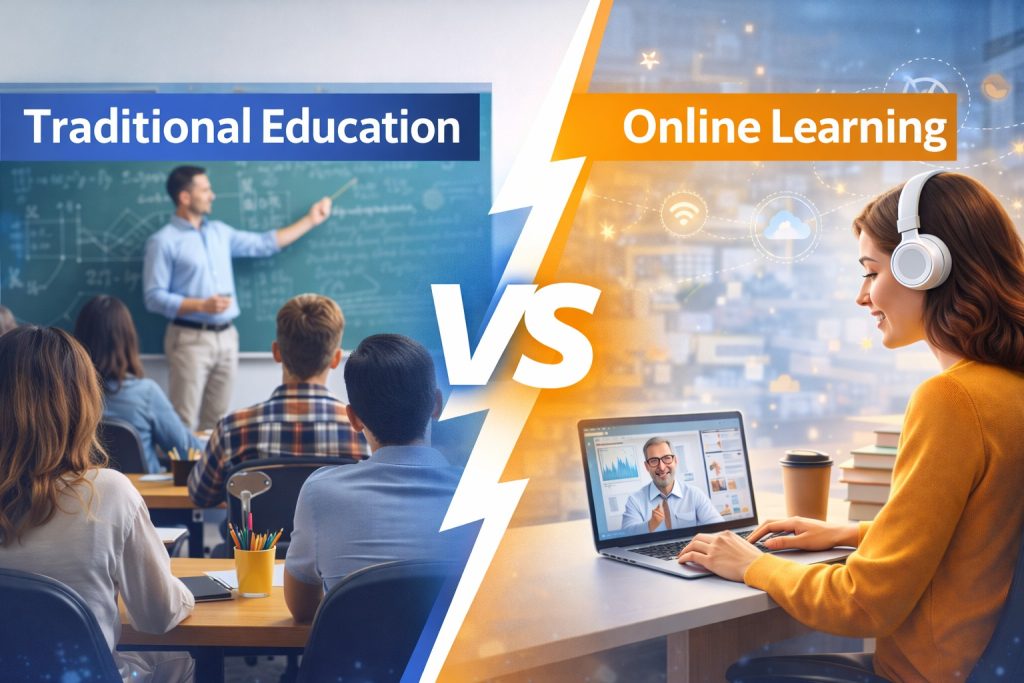
Comparison of Traditional Education and Online Learning
Both traditional education and online learning have their own merits and shortcomings. Traditional education offers structured environments, face-to-face discussion venues and social activities opportunities that are rare in other types of education. It is especially good for young students who need guidance and oversight. On the other hand, online learning presents a range of benefits, like flexibility, self-pacing and access to global educational resources. It may also be the most suitable mode for adult learners, working professionals and students that work their course independently.
Classroom teaching involves physical rooms and interactions close to the teacher. In contrast, online learning is platform-friendly and allows students much greater autonomy. Traditional education stresses medium interaction in the classroom and group activities, whereas online learning centers attention around the individual learner and collaboration with others via digital techniques. Traditional Education vs Online Education
The Role of Technology in Modern Education
Technology has played an essential role in moving traditional education closer to online learning. Now many educational institutions use models of learning that blend classroom instruction and web-based tools., The traditional teaching setting can be flexible with Today ‘s high-tech means of communication as well taking on a more relaxed environment set by internet communication tools will provide, however through all this great diversity we find our own reeds to an unknown destination!
For example, instead of traditional classroom teaching only, teachers may provide online resources, recorded lessons and digital assignments. By combining both approaches it enhances the learning experience. Learning management systems, virtual classrooms, and educational applications are making it easier than ever for teachers to build highly interactive in-depth learning environments.
Choosing the Right Means Learning
Whether the use of traditional education or online learning is preferable depends upon individual preferences, learning style and personal circumstances. Students who like structured environments, direct access to instructors, and a place to voice their opinions (campus life) could benefit more from traditional education.
On the other hand, students who need flexibility, want to learn at their own pace or require access to communities of educational resources on a global basis may find online learning more appropriate. So, exists in parallel or complementary forms. And for some learners the best option of all might just be one in which both methods are used–in with its online courses to complement the traditional classroom education.

The Future of Education
The future of education will be an extension of traditional teaching methods. At the same time, online learning is integrating many new technologies such as: artificial intelligence, virtual reality and interactive digital tools for multimedia presentations that are altering how we transmit knowledge.
More and more educational institutions are now adopting hybrid learning models that combine classroom teaching with digital resources. This method of approach provides students the flexibility that comes with online courses while still preserving all benefits available to them from face-to-face interaction. With the further development of science and technology, the features of educational systems will become more personal as well as efficient accessible.
Computer
Amazon Basicsacer Aspire Lite, AMD Ryzen 3-5300U, 8 GB RAM, 512 GB SSD, Full HD 15.6″/39.62 cm, Windows 11 Home, Steel Gray, 1.59 KG, AL15-41, Premium Laptop
36,xxx from Amazon 36,999 from Amazon


