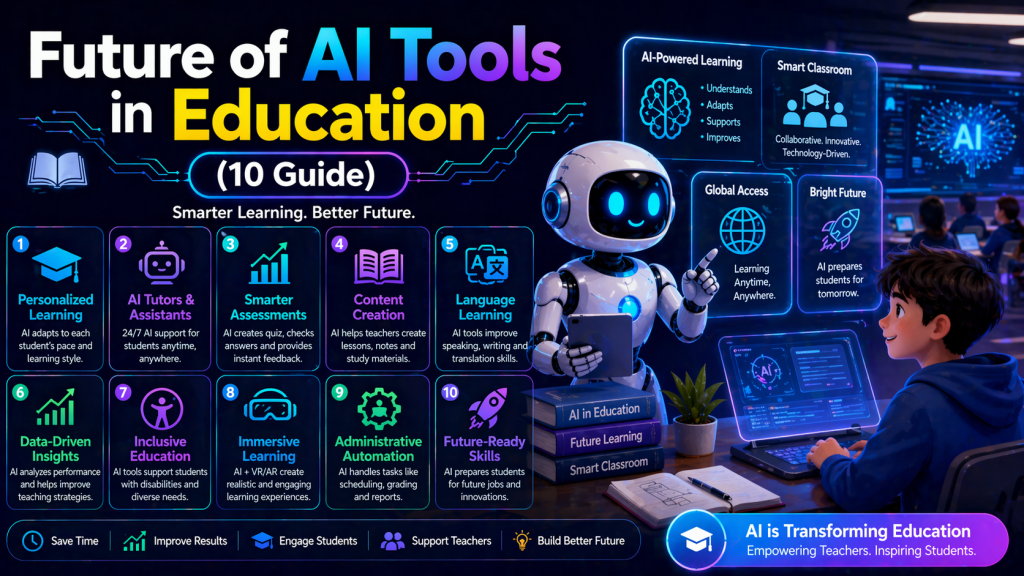
Future of AI Tools in Education 10 Guide
Introduction
Education is changing rapidly in the digital age, and Artificial Intelligence (AI) is one of the biggest forces driving this transformation. From smart classrooms to personalized learning platforms, AI tools are helping students learn faster and teachers teach more effectively. Technology is making education more accessible, interactive, and efficient than ever before. Future of AI Tools
In the past, education mainly relied on textbooks and traditional teaching methods. Today, AI tools can analyze student performance, provide instant feedback, create customized lessons, and automate administrative tasks. These tools are improving the quality of education and preparing students for the future job market. Future of AI Tools
In this guide, we will explore the future of AI tools in education, their benefits, emerging trends, challenges, and how they will shape learning in the coming years. Future of AI Tools
What Are AI Tools in Education?
AI tools in education are software applications that use artificial intelligence to support teaching and learning processes. These tools can perform tasks that normally require human intelligence, such as understanding language, recognizing patterns, and making decisions. Future of AI Tools
AI education tools can help with:
- Personalized learning
- Future of AI Tools
- Homework assistance
- Exam preparation
- Content creation
- Student performance tracking
- Classroom management
- Language learning
- Online education
These tools are making education smarter and more efficient.
Why AI Tools Are Important for the Future of Education
Education systems around the world face many challenges, including large class sizes, limited resources, and different learning abilities among students. AI tools help solve these problems by providing flexible and personalized learning experiences.
AI tools are important because they:
- Improve learning speed
- Support individual learning styles
- Future of AI Tools
- Reduce teacher workload
- Increase student engagement
- Provide instant feedback
- Improve academic performance
- Make education accessible worldwide
- Prepare students for future careers
As technology continues to grow, AI tools will become a core part of education systems.
Key Trends in the Future of AI Tools in Education
1. Personalized Learning
Personalized learning is one of the most important trends in modern education. AI tools can analyze student data and create customized lessons based on individual needs.
In the future:
- Students will learn at their own pace
- Lessons will adapt automatically
- AI will identify learning gaps
- Students will receive personalized recommendations
This approach will improve understanding and academic success.
2. AI-Powered Virtual Tutors
Virtual tutors are AI systems that provide learning support anytime and anywhere. They can answer questions, explain concepts, and guide students through lessons.
Future virtual tutors will:
- Provide 24/7 support
- Offer step-by-step explanations
- Support multiple languages
- Help students prepare for exams
Virtual tutors will make learning more flexible and accessible.
3. Smart Classrooms
Smart classrooms use AI technology to create interactive learning environments. These classrooms include digital boards, sensors, and AI-powered software.
Future smart classrooms will:
- Monitor student attention levels
- Adjust teaching methods automatically
- Provide real-time feedback
- Improve classroom management
Smart classrooms will enhance student engagement and learning outcomes.
4. Automated Grading Systems
Grading assignments and exams takes time and effort. AI tools can automate grading quickly and accurately.
In the future:
- Exams will be graded instantly
- Students will receive immediate feedback
- Teachers will save time
- Errors in grading will be reduced
Automated grading systems will improve efficiency in education.
5. AI in Online Learning
Online learning is becoming more popular worldwide. AI tools are improving online education by making it more interactive and personalized.
Future AI online learning systems will:
- Recommend courses based on interests
- Track learning progress
- Provide real-time assistance
- Create interactive lessons
AI will make online education more effective and engaging.
6. Language Translation and Communication
Language barriers can make learning difficult. AI tools can translate languages instantly and improve communication.
In the future:
- Students will learn in their native language
- Teachers will communicate globally
- Educational resources will be available worldwide
- Language barriers will be reduced
This will make education more inclusive.
7. AI-Powered Content Creation
Teachers spend a lot of time preparing lessons and materials. AI tools can generate educational content automatically.
Future AI tools will:
- Create lesson plans
- Generate quizzes
- Design presentations
- Produce educational videos
This will allow teachers to focus more on teaching.
Benefits of AI Tools in Education
AI tools offer many advantages for students, teachers, and educational institutions.
1. Improved Learning Experience
AI tools make learning more interactive and engaging through videos, simulations, and virtual reality.
2. Time Saving
AI automation reduces repetitive tasks such as grading and scheduling.
3. Better Academic Performance
AI tools help students understand concepts more easily.
4. Accessibility
AI tools make education available to students in remote areas.
5. Cost Efficiency
Digital tools reduce the need for physical resources.
6. Data-Driven Decisions
AI analyzes student performance data to improve teaching methods.
How AI Tools Will Impact Students
AI tools will change the way students learn and study.
Students will benefit from:
- Personalized learning plans
- Faster feedback
- Flexible study schedules
- Interactive learning experiences
- Access to global resources
- Improved academic performance
AI will help students become independent learners.
How AI Tools Will Impact Teachers
AI tools will support teachers and improve teaching methods.
Teachers will be able to:
- Track student progress easily
- Create better lesson plans
- Provide personalized guidance
- Save time on administrative tasks
- Improve classroom management
AI will assist teachers rather than replace them.
Future Technologies in AI Education
Several advanced technologies will shape the future of education.
1. Virtual Reality (VR)
VR will allow students to explore virtual environments such as science labs and historical locations.
2. Augmented Reality (AR)
AR will add digital elements to real-world environments, making learning more interactive.
3. Robotics
Educational robots will help students learn programming and problem-solving skills.
4. Predictive Analytics
AI will predict student performance and identify learning challenges early.
5. Blockchain Technology
Blockchain will secure academic records and certificates.
Challenges of AI Tools in Education
Despite many benefits, AI tools also have some challenges.
1. High Implementation Cost
Developing AI systems can be expensive for schools.
2. Data Privacy
Student data must be protected from misuse.
3. Technical Skills Requirement
Teachers and students may need training to use AI tools.
4. Dependence on Technology
Overuse of AI may reduce human interaction.
Future of AI Tools in Schools, Colleges, and Universities
In Schools
AI will help improve classroom learning and student engagement.
Examples:
- Smart classrooms
- Automated attendance
- Interactive lessons
In Colleges
AI will support research and career planning.
Examples:
- AI-based career guidance
- Virtual laboratories
- Online learning platforms
In Universities
AI will improve research and innovation.
Examples:
- Advanced research tools
- Global collaboration
- Automated administration
How Students Can Prepare for the Future of AI in Education
To succeed in the AI-driven education system, students should develop important skills.
These skills include:
- Digital literacy
- Critical thinking
- Problem-solving
- Creativity
- Communication
- Programming basics
- Data analysis
- Adaptability
These skills will help students succeed in future careers.
Conclusion
The future of AI tools in education is bright and full of opportunities. AI is transforming traditional education into a smarter, more efficient, and personalized system. It helps students learn better, supports teachers in their work, and improves the overall quality of education.
While there are challenges such as cost and data privacy, the benefits of AI in education are much greater. With responsible use and proper planning, AI can create a modern education system that prepares students for the future.
As technology continues to evolve, AI tools will become an essential part of education, shaping the way we learn, teach, and grow in the digital world.