

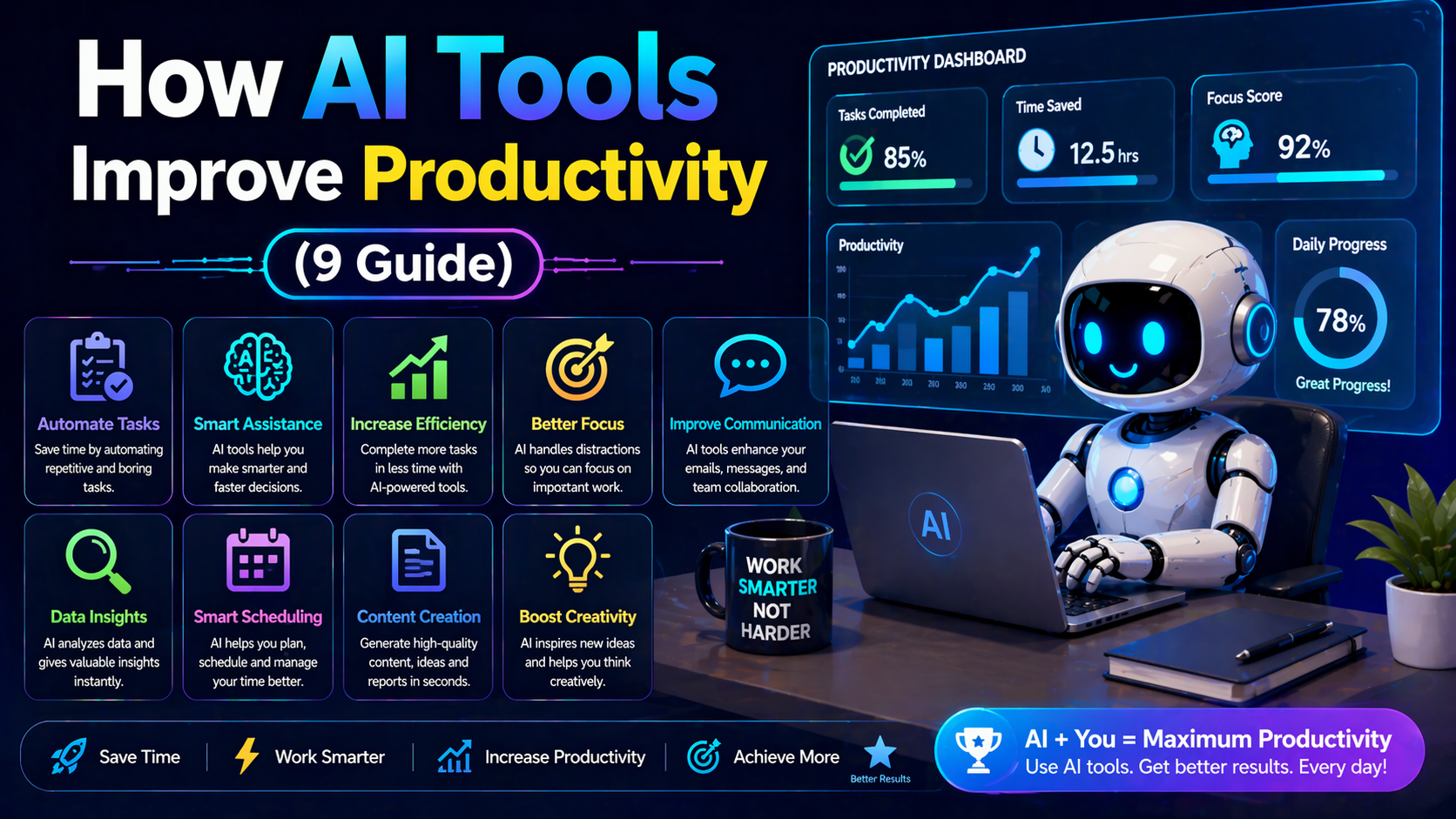
How AI Tools Improve Productivity (9 Guide)
Introduction
In today’s fast-moving digital world, productivity has become one of the most important factors for success. Whether you are a student, employee, freelancer, or business owner, completing tasks quickly and efficiently is essential. However, managing time, handling multiple tasks, and maintaining quality can be challenging. How AI Tools Improve Productivity
Artificial Intelligence (AI) is helping people improve productivity by automating tasks, organizing work, and providing smart suggestions. AI tools can write documents, manage schedules, analyze data, and perform repetitive tasks automatically. These tools save time, reduce stress, and help people focus on more important work. How AI Tools Improve Productivity
In 2026, AI tools are widely used in education, business, healthcare, and daily life. In this guide, we will explore how AI tools improve productivity, their benefits, examples, and tips for using them effectively.
What Is Productivity?
Productivity refers to the ability to complete tasks efficiently and achieve better results in less time. It measures how effectively people use their time, skills, and resources.
For example:
- Completing assignments quickly
- Managing time effectively
- How AI Tools Improve Productivity
- Reducing errors
- Finishing projects on schedule
- Achieving goals faster
High productivity helps individuals and organizations succeed.
What Are AI Productivity Tools?
AI productivity tools are software applications that use artificial intelligence to help users complete tasks faster and more efficiently. These tools analyze information, learn from data, and provide useful suggestions.
AI productivity tools can perform tasks such as:
- Writing emails and documents
- Scheduling meetings
- Organizing tasks
- Analyzing data
- How AI Tools Improve Productivity
- Creating presentations
- Managing projects
- Automating workflows
- Providing reminders
These tools help users work smarter instead of harder.
Why AI Tools Are Important for Productivity
AI tools are becoming essential because modern work environments require speed, accuracy, and efficiency. Manual work can be time-consuming, while AI tools complete tasks quickly.
AI tools improve productivity by:
- Saving time
- Reducing workload
- How AI Tools Improve Productivity
- Increasing accuracy
- Improving organization
- Supporting teamwork
- Enhancing decision-making
- Reducing stress
- Boosting performance
As technology continues to grow, AI tools will become a standard part of daily work.
Ways AI Tools Improve Productivity
1. Automating Repetitive Tasks
Many tasks are repetitive and time-consuming, such as data entry, email responses, and report generation. AI tools automate these tasks automatically.
Examples:
- Sending automatic replies
- Filling forms
- Sorting emails
- How AI Tools Improve Productivity
- Generating reports
Automation allows people to focus on important tasks.
2. Improving Time Management
Time management is essential for productivity. AI tools help users plan schedules and manage deadlines.
Examples:
- Setting reminders
- Scheduling meetings
- Tracking tasks
- How AI Tools Improve Productivity
- Managing calendars
These tools help users stay organized and avoid missing deadlines.
3. Enhancing Communication
Communication is an important part of productivity. AI tools help people communicate more effectively.
Examples:
- Writing emails
- Translating languages
- Creating meeting summaries
- Chat support
AI communication tools improve clarity and save time.
4. Supporting Decision-Making
AI tools analyze data and provide insights that help users make better decisions.
Examples:
- Sales forecasting
- Business analytics
- Performance tracking
- Market analysis
These tools reduce guesswork and improve results.
5. Increasing Work Efficiency
AI tools help users complete tasks faster and with fewer errors.
Examples:
- Code generation
- Document editing
- Task automation
- Workflow management
This increases overall efficiency.
6. Reducing Human Errors
Mistakes can reduce productivity and cause delays. AI tools detect errors and suggest corrections.
Examples:
- Grammar checking
- Data validation
- Error detection
- Quality control
Reducing errors improves work quality.
Examples of AI Tools That Improve Productivity
1. ChatGPT
ChatGPT helps users write content, answer questions, and generate ideas quickly.
Uses:
- Writing assignments
- Research support
- Content creation
- Problem-solving
2. Notion AI
Notion AI helps users organize notes, tasks, and projects.
Uses:
- Task management
- Project planning
- Note-taking
- Collaboration
3. Grammarly
Grammarly improves writing by correcting grammar and spelling mistakes.
Uses:
- Email writing
- Document editing
- Essay writing
4. Microsoft Copilot
Microsoft Copilot helps users create documents, analyze data, and manage emails.
Uses:
- Document creation
- Data analysis
- Presentation design
5. Trello
Trello helps teams manage projects and track progress.
Uses:
- Task management
- Workflow tracking
- Team collaboration
6. Zapier
Zapier automates workflows between different applications.
Uses:
- Task automation
- Data transfer
- Process management
7. Google Gemini
Google Gemini helps users perform research and generate content quickly.
Uses:
- Research assistance
- Content generation
- Problem-solving
Benefits of AI Tools for Productivity
AI productivity tools offer many advantages.
1. Saves Time
AI tools complete tasks faster than manual work.
2. Improves Accuracy
AI tools reduce mistakes and improve quality.
3. Increases Efficiency
AI tools help users complete more work in less time.
4. Reduces Stress
Automation reduces workload and pressure.
5. Enhances Collaboration
AI tools help teams work together effectively.
6. Supports Remote Work
AI tools make it easier to work from anywhere.
How AI Tools Improve Productivity in Different Fields
Education
AI tools help students and teachers manage assignments, research, and learning.
Examples:
- Homework assistance
- Study planning
- Online learning support
Business
Businesses use AI tools to improve operations and customer service.
Examples:
- Customer support chatbots
- Sales forecasting
- Marketing automation
Healthcare
AI tools help doctors manage patient data and improve treatment.
Examples:
- Medical record management
- Diagnosis support
- Appointment scheduling
Freelancing
Freelancers use AI tools to manage projects and communicate with clients.
Examples:
- Content creation
- Task scheduling
- Invoice generation
Future of AI Productivity Tools
The future of AI productivity tools is very promising. As technology continues to advance, AI tools will become more powerful and intelligent.
Future developments may include:
- Fully automated workplaces
- Smart personal assistants
- Voice-controlled productivity tools
- Predictive task management
- Real-time collaboration
- AI-powered decision-making
- Advanced workflow automation
AI will transform the way people work in the future.
Tips for Using AI Tools to Improve Productivity
To use AI tools effectively, follow these tips:
- Choose the right tool for your task
- Set clear goals
- Automate repetitive work
- Review AI-generated results
- Learn new features regularly
- Stay organized
- Manage time properly
These tips help maximize productivity.
Challenges of Using AI Tools
Although AI tools are helpful, they also have some challenges.
1. Learning Curve
New users may need time to understand how tools work.
2. Data Privacy
Users must protect sensitive information.
3. Cost
Some advanced tools require paid subscriptions.
4. Dependence on Technology
Overreliance on AI may reduce human skills.
Conclusion
AI tools are transforming productivity in education, business, and everyday life. They help people complete tasks faster, reduce errors, and manage time effectively. In 2026, AI productivity tools have become essential for students, professionals, and organizations.
By using AI tools wisely, individuals can improve efficiency, reduce stress, and achieve better results. As artificial intelligence continues to evolve, productivity will increase, and work will become smarter and more efficient.

1 Comment
Pingback: Future of AI Tools