
Importance of education
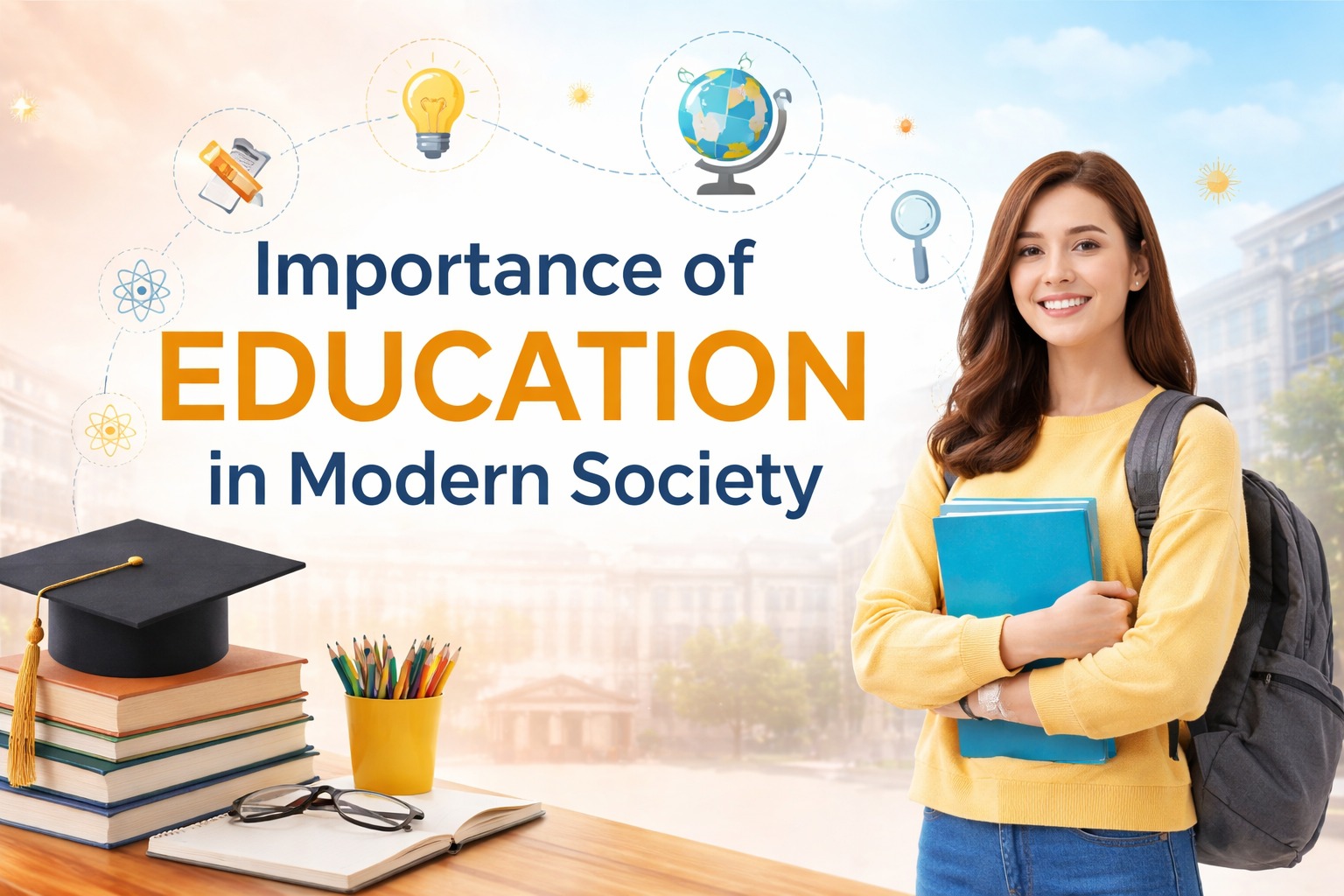
The Importance of Education in Modern Society Education is one of the most powerful tools for personal growth and social development. In shaping the shape of individuals, communities, and even nations, education also plays a key role. It not only offers knowledge and skills but also enables people to think critically, it inspires creativity, and gives everyone the ability to encounter problems with an open mind. In today’s rapidly changing world, education has become more important than ever. It serves as a foundation for progress, innovation and a better standard of living.
Understanding education Education
Understanding education Education is the process of acquiring knowledge, skills, values, beliefs and habits through learning, teaching, training and research. Whether it is formalized in structures such as schools or carried on informally inside people’s everyday lives, it can occur in two types of setting. Education lets people understand the world around them and gives rise to all tools needed for success in life.
Education as the Basis for Personal Development A key function of education is personal development. Education enables people to discover their talents, interests and ability. And education brings greater self-confidence, supporting people in their own goals and ambitions.
Through education, people learn essential life skills such as communication, teamwork, leadership, and decision-making. Both on personal and professional levels, these are necessary for success. Education also helps people to cultivate a sense of self-discipline and responsibility. They are crucial for achieving long-term targets.
Importance of education
More generally, education stimulates people’s curiosity, when taken in this broad and profound way of meaning the term. A person who erudite is more inclined to explore new ideas, question conventional thinking and seek solutions to problems.
Education: Carrying Through All Sorts of Changes
In order to achieve economic gain, education is essential. A trained, educated labor force equates to a growing industries and businesses. Countries that are strong in education usually see economic growth rates well above the international average
Education helps individuals acquire the necessary knowledge and technical skills to become employed. It broadens job opportunities, helps people to make more money. Therefore education is a means fob defeatting poverty and promoting financial stability.
In modern society, industries are always on the edge of transforming due to technological change. However, if properly educated, this allows workers to adapt. In addition, they gain new knowledge and capabilities. Therefore, individuals remain competitive in the job market.
Promoting Social Equality Education is one of the most effective means available. It does indeed afford equal opportunities to all comers, no matter what their background. When good education is available to people, the result is that they can break through both social and economic barriers.
Education helps people at the bottom of society, raising them up. Girls can become independent, Women participate actively in society instead of being shut out of it. So, as a single example. sparking off improvements in family health and economics of a community.
In modern society, education also encourages inclusiveness and diversity. It asks for respect and understanding of other cultures, traditions, and perspectives. This helps create a more peaceful society.
Education & Technological Development
Today’s world is driven by science and technology. In training people to utilize new technology or develop new techniques, education plays a crucial role. Fields such as computer science, engineering, medicine, and artificial intelligence all depend on education and investigation. Long-term support from its governments sustains this lifeblood of future progress and prosperity.
More than ever before, Although digital literacy necessity are studying and making education part. The world in which we live means that in a large number of jobs today, it is essential to understand computers as well as the internet’s operation and related digital tools. Today, it can be said that educational institutions try to integrate technology into their programs for learning not so much of the present but largely looking ahead. This approach in education aims to prepare students not only for their immediate future in a rich and fulfilling life but also beyond into the future global age.
Education and responsible citizenship Education has contributed to the development of individuals with a sense of responsibility and informed citizens. It teaches people what their rights are and also responsibilities in society, thus making even better citizens for our world. With better education citizens are more interested in and do take part actively in the democratic political process, they participate more in activities like voting, community service and public discussion.
Civic education imparts to people an understanding of social issues, government policies, and global challenges that will help shape individuals- and the world. This knowledge allows people to make informed decisions about what they are doing in society. They can do Profession to Society as an influencer rather than being influenced by society. In addition, education also cultivates ethical values like honesty, respect and compassion. These are essential for creating good communities. Education and health consciousness Another important benefit of education is that it raises awareness about health.
Educated individuals are better able to understand what healthy living means, proper nutrition and how to keep clean. Education enables people to make informed decisions about their health and welfare. For instance, a well-educated mother is more likely to be alert in ensuring that her children receive medical care and are well educated. Studies have shown that countries with higher literacy rates often experience lower infant mortality rates disease levels drop dramatically.
Life expectancy is also longer for the populace as a whole within such states–this to some extent is undoubtedly related to their success in education Education in the Digital Age The digital age has changed the way we study online. Students from other countries can take classes offered by Importance of education institutions in a certain country, at any time and over the entire world! Virtual classrooms, web-based learning communities and educational apps are now making study easier for people to learn anywhere, anytime. Technology has created an environment for customized educational experiences. Students can progress at their own pace and use a variety of resources. People have therefore more opportunities to learn throughout life.
Nevertheless, the digital age has its own predicament: the digital divide. This refers to communities that lack technology and an internet connection. These predicaments need addressing if everyone is to enjoy contemporary education.
Part III Teachers and educational institutions
The future of society belongs to the teachers and educational institutions. Teachers not only pass on knowledge but also, what is perhaps more important in education, they guide students’ trains of thought and inspire their potential.
Educational institutions provide structured environments in which students can develop both academically and socially. In addition, both academic institutions and industrial training places are great breeding grounds for research, creativity, and innovation.
In modern society, teachers must be able to communicate with students in new ways and make use of fresh technological devices to create effective learning. It is particularly important for educators to keep up-to-date through continuous professional development; so that they are always competent to perform their roles effectively.
Part IV Challenges to Modern Education
Despite its vital importance, modern education is confronting many challenges, such as disparate educational opportunities, inadequate resources, out-of-date curriculums and increasingly expensive higher education.
In many parts of the world, children do not have basic education because they are poor, in areas of conflict or subject to barriers. Governments and societies need to use their brains in collaboration to solve these issues. This way education can be available to all for future generations.
Another problem stems from the fact that students are still being trained for jobs that have not yet emerged into existence. Indeed, as technology develops, the education system must increasingly make provision for people to acquire adaptable skills such as how to think critically or creatively, and problem-solving capabilities.
Part V The Future of Education
The shape of future education is as likely to be transformed by innovation and technology and to rest on global cooperation as it is going to be featured by confusion or corruption brought on by artificial intelligence. Anyway for all time, an advanced learning platform future reality
Education will also move towards lifelong learning. As the world changes ever more rapidly people will have to keep updating their skills and knowledge again.
The system of education will also put more of an emphasis on practical work, creativity, and interdisciplinary studies. There will be a new set of changes in educational systems: Getting students ready for employment or further study will not be the be-all and end-all of education.

3 Comments
Pingback: Future of Digital Education in the Digital success
Pingback: Traditional Education vs Online Education: 7 Powerful Differences Every Student Should Know
Pingback: AI 10 Tools Every Student Should Try